
Mouse Care Guide
Quick Care Overview
- Lifespan: 1.5 to 3 years
- Social needs: Social animals. Keep females in pairs or small groups. Unneutered males may live alone but need extra enrichment and attention.
- Minimum enclosure size: 600 sq in of unbroken floor space (40-gallon tank or larger)
- Bedding depth: At least 6 inches of substrate for burrowing
- Food: Lab blocks or pellets supplemented with fresh fruits, vegetables, and protein
- Wheel: At least 8 inches, solid surface only
- Cleaning: Spot-clean daily, full clean (changing 2/3 of the bedding) every 2 weeks
- Activity: Nocturnal. Most active after dark.
- Vet: Exotic vet required. Find one before you need one.
Fancy mice need companions. A single mouse living alone will be stressed, lonely, and more prone to health problems.
In the wild, mice live in large social groups, and pet mice retain that same need for company. We recommend keeping a group of at least three female mice. Start with two and introduce a third about six months later, then a fourth six months after that. This creates a “rolling group” of mixed ages, which means no mouse is left alone if a companion passes away. Mixed-age groups also tend to get along better than same-age groups.
What about males?
Unneutered male mice should typically live alone. Males can be aggressive toward other males, and housing them with females will result in babies. The better option is to neuter your male mouse and house him with a group of females. Some male mice can also live with female African soft-fur rats as companions.
For more on housing male mice, see my article on whether male mice can live alone. If you’re adding new mice to an existing group, my mouse introductions guide covers how to do it safely.
Common mistake: Getting just one mouse because you “only want one pet.” A lone female mouse isn’t a low-maintenance pet. She’s a stressed, understimulated animal. If you’re not ready for a small group, a hamster (which is solitary) may be a better fit.
Where to Get Mice
We strongly recommend adopting your mice from a rescue or an ethical breeder rather than buying from a pet store.
Chain pet stores source their animals from large-scale breeding facilities where animals are often kept in poor conditions and frequently mis-sexed. A mis-sexed “pair of females” from a pet store can quickly become a pregnant mouse and a dozen unexpected pups. Pet store staff are rarely trained in mouse care and may give you inaccurate advice about housing, diet, and social needs.
Rescues are more likely to know the sex, age, and health history of their animals. When they can, they handle their mice from a young age and get them use to socializing with humans, which makes bonding much easier. A rescue also gives mice a second chance at a good home, and there are more mice in rescues than most people realize.
We maintain a database of small pet rescues across the US that work with hamsters, gerbils, and mice.
For more on why we feel strongly about this, read our article on why you shouldn’t buy a small pet from a pet store.
Enclosures
Most cages sold as “mouse cages” are too small, poorly ventilated, or easy to escape from.
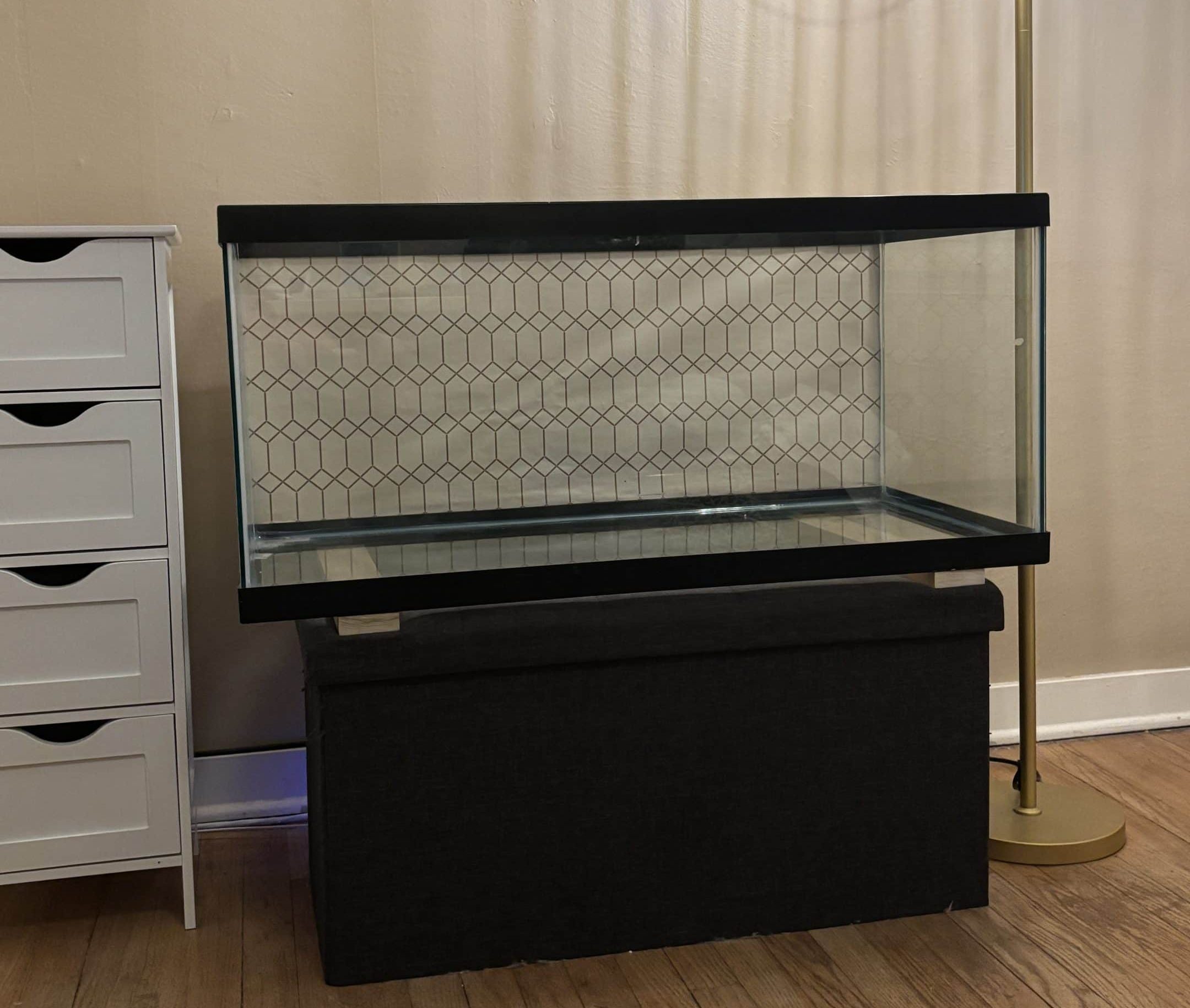
40-gallon tank mouse enclosure before filling with bedding and enrichment items
Mice need a minimum of 600 square inches of unbroken floor space. Levels and platforms don’t count toward this because mice spend most of their time on the ground floor, burrowing and nesting. (Climbing areas count as important enrichment rather than space.) A 40-gallon tank is a reasonable starting point for two to four mice, but bigger is always better.
Enclosure options
- Glass tanks: Hold deep bedding well and prevent escapes. A 40-gallon breeder tank works for a small group. The downside is weight and the need for a secure mesh lid for ventilation. Very deep tanks don’t allow sufficient airflow, and ammonia (which is heavier than air) sinks to the bottom where your mice live. If you use a deep tank, you may need to clean it more frequently.
- Wire cages: Work well if the bar spacing is 1 cm or smaller and the base is deep enough for burrowing. Mice can squeeze through anything larger. The floor and any platforms must be solid, not wire or mesh, which damages their feet. Wire cages have better ventilation than tanks, but they often aren’t as sturdy or built to meet mice’s space requirements.
- Bin cages: A large plastic storage bin with ventilation cut into the lid (covered with hardware cloth) is an affordable DIY option.
What to avoid
- Wood enclosures. Mouse urine damages wood and causes ammonia buildup, and mice can chew through it.
- Wire or mesh flooring. It causes foot injuries and bumblefoot.
- Any enclosure marketed as a “mouse cage” without checking the floor space yourself.
Common mistake: Using a 10-gallon tank because a website said it was fine. Almost every experienced mouse owner will tell you it’s far too small for even two mice or a single male once you add bedding, hides, a wheel, and food.
For specific enclosure recommendations, see my best mouse cages guide, and for help figuring out what size you need, check out mouse cage size.
Watch me set up a full mouse enclosure on Instagram!
Bedding
Mice are burrowers, and deep substrate is one of the most important things you can provide.

10+ inches of bedding for burrowing
Your mice need at least 6 inches, and ideally 8-10 inches of substrate in at least 1/3 to 1/2 of their enclosure so they can dig tunnels and build nests underground. There are four types of bedding that each serve a different purpose. You don’t need all four all the time, but many owners find a combination works best.
Substrate (covers the entire enclosure floor)
This is your base layer. Good options include aspen shavings, shredded paper or cardboard, coco coir, and hemp fiber. Paper-based bedding like Kaytee Clean & Cozy also works well. The substrate needs to be deep enough for burrowing and absorbent enough to manage moisture.
Nesting material (mice collect this to build nests)
Provide materials your mice can gather and arrange themselves: tea bag paper, shredded paper, and soft hay all work. Mice will shred and rearrange these into nests both above ground and in their burrows.
Litter (for corners where mice go to the bathroom)
Mice tend to pick specific corners or areas in their enclosure for their “bathroom.” You can put absorbent paper pellets in these spots to make cleanup easier and reduce odors. Avoid wood pellets, as they break down into sawdust when wet.
Digging material
Some mice enjoy digging in a dig box, which you can fill with coco fiber. Sprinkle seeds or mealworms into the soil and let them forage and dig like they would in nature.
What to avoid
Cedar and untreated pine shavings (toxic or irritating to respiratory systems), cotton-based “fluffy” nesting material (wraps around limbs), scented bedding, and corn cob bedding (molds quickly).
Common mistake: Only putting an inch or two of bedding in the enclosure. Mice can’t burrow in shallow substrate, which means they’re missing out on one of their most important natural behaviors.
Tip: Some mice are bigger burrowers than others! You’ll only find out if your mouse has the urge to burrow if you give them enough bedding to do so. If they don’t enjoy it, you might choose to use the space for other types of enrichment, like climbing, instead.
For a full comparison of bedding options, see my best bedding for mice guide. We also have an article on whether corn cob bedding is safe if you’ve seen it recommended elsewhere.
Enrichment and Wheels
Mice need their enclosure packed with things to climb, hide in, and explore. Mice are prey animals, and open space makes them feel exposed and vulnerable.
Every area of the enclosure should have some kind of cover nearby, whether that’s a hide, tunnel, bridge, or pile of nesting material. Think of it less like decorating and more like filling a habitat.
Hides and Tunnels
Provide multiple hideouts so each mouse has options. Toilet paper rolls, small ceramic pots, coconut shells, cork logs, and wooden houses all work. The more hiding spots you offer, the less territorial conflict you’ll see in groups.
Climbing
Unlike hamsters, mice are excellent climbers and actually use vertical space. Ropes, hammocks, wooden bridges, and platforms at different heights give them opportunities to climb and explore. Just make sure any heights have soft landings (deep bedding below), or integrate fall-breakers, like fleece hammocks, in case of falls.
Wheels
Mice need a wheel. Provide at least one upright wheel at minimum, and ideally a large flying saucer wheel as well. The wheel should be at least 8 inches in diameter for small mice, and 10 inches in diameter for medium or large mice. Mice can use wheels up to 11 inches with ease. Wheels must also have a solid running surface. Wire or mesh wheels catch toes and cause injuries.
Common mistake: Leaving large open areas in the enclosure because it “looks cleaner.” Mice crave novelty and clutter, so adding in a new piece every other day or so can help keep things cozy and fresh at the same time.
For specific wheel recommendations, see my best wheels for pet mice guide.
Food and Water
Mice need a balanced diet of lab blocks or pellets, supplemented with fresh foods and the occasional protein treat.
A good base diet is a quality mouse-specific lab block or pellet. These are nutritionally complete and prevent selective eating, which is a common problem with seed mixes (mice will pick out the tasty bits and leave the nutritious ones).
We use and recommend Oxbow Essentials Mouse & Young Rat Food as a base pellet. For a full breakdown of our recommended foods, see our best food for pet mice guide.
Common mistake: Relying on a seed mix as the primary diet. Mice will selectively eat the high-fat seeds and leave the rest, leading to obesity and nutritional gaps. Lab blocks as a base diet prevent this. See our best food for pet mice guide for specific product recommendations.
Fresh foods
Supplement the base diet with small amounts of fresh vegetables (broccoli, peas, cucumber, carrot) and occasional fruit (in moderation due to sugar). Mice can also eat protein sources like dried mealworms, crickets, and small amounts of cooked egg or chicken.
For a complete guide to mouse nutrition, including what’s safe and what to avoid, see our guide on what to feed pet mice.
Scatter feeding
Rather than using a food bowl, scatter your mice’s food throughout the bedding and enclosure. This mimics natural foraging behavior and provides mental stimulation. Mice are hardwired to search for food, so making them work for it is enriching, not cruel.
I scatter feed whenever I can’t see any food on the surface of the bedding anymore, which for my group is usually every two to three days.
Foraging sprays
In addition to scattered food, foraging sprays encourage natural foraging behavior for mice. These come in a wide variety that are safe for small pets, like millet, wheat, flax, sorghum, and oat.
Water
Fresh water must be available 24/7. A water bottle is better than a dish, if you can only use one, because mice will quickly contaminate a bowl with bedding and droppings. However, it’s ideal to give your mice both options. If your mice chew their plastic water bottle, switch to a glass one. Check the bottle daily to make sure it’s dispensing properly, and keep the water in their dish fresh and clean.
Coprophagy in mice
If you see your mouse eating its own droppings, that’s normal. Mice do this to absorb nutrients they didn’t fully process the first time through. It’s not a sign of illness or nutritional deficiency.
Cleaning
A dirty enclosure leads to respiratory infections and potentially bumblefoot. Keeping up with cleaning is one of the most important things you do as a mouse owner.
Daily/every other day: Spot-clean
Check for soiled litter and wet bedding, especially in the corners or other areas where your mice tend to go to the bathroom. Remove the dirty bedding and replace it with fresh material. This takes just a few minutes.
Every 2 weeks (approximately): Full clean
Remove all the bedding, wash the enclosure with a pet-safe spray cleaner, and add fresh substrate. The frequency depends on enclosure size. Larger enclosures need full cleaning less often. Smaller setups may need it weekly.
Important: When you do a full clean, mix some of the old bedding in with the new. Mice rely heavily on scent to feel safe. A completely fresh enclosure with no familiar smells is stressful and can trigger fighting in groups as they re-establish territory. We try to mix back in about 1/3 of the old bedding, or less depending on the size of the enclosure.
Common mistake: Cleaning too thoroughly. It sounds counterintuitive, but scrubbing everything spotless and replacing all the bedding at once removes the scent markers your mice depend on. Keep some of the old bedding to mix in.
Sleep Schedule
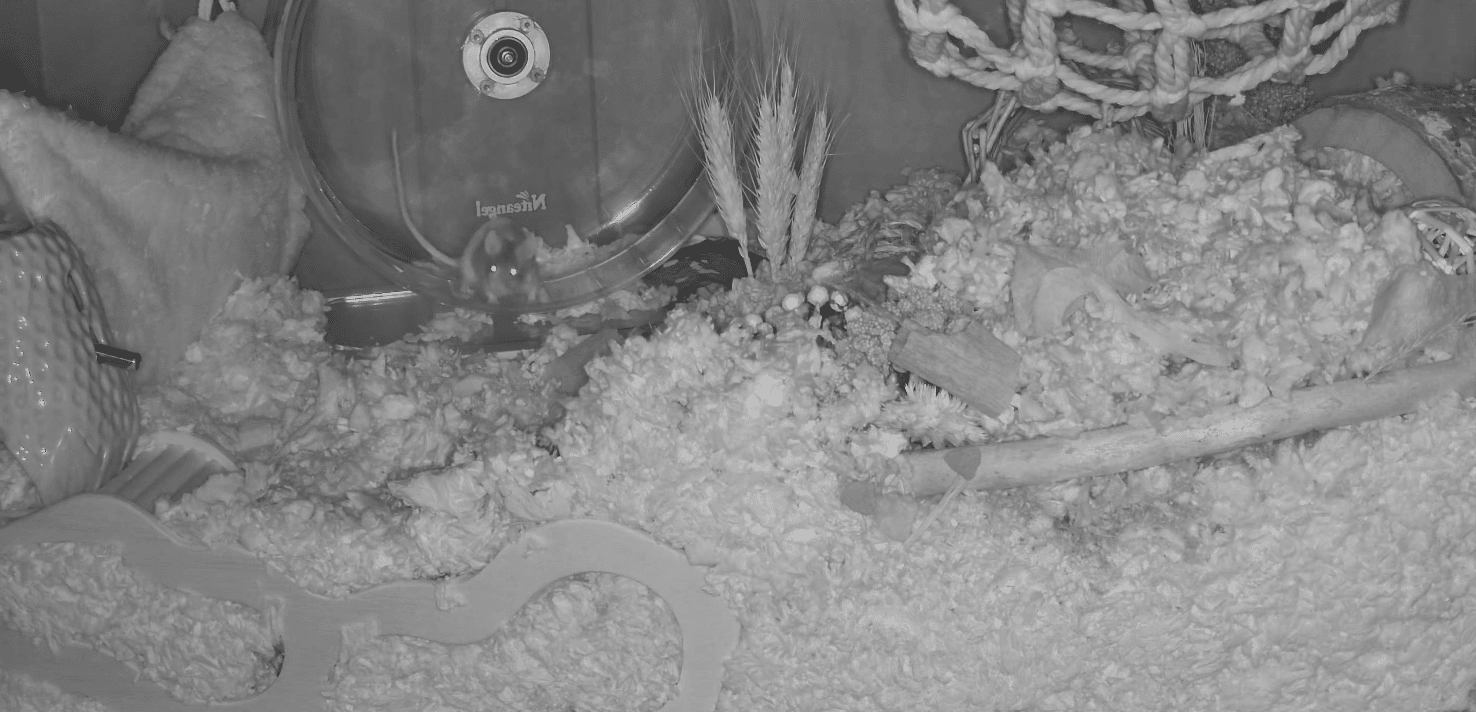
My mouse, Piper, on the wheel at night – caught on infrared camera
Mice are typically nocturnal, although they can adjust to your schedule over time. They sleep during the day and are most active after dark. Some mice start getting active at dusk.
If you rarely see your mice during the day, that’s completely normal. They’re sleeping, and waking them up causes stress. It’s best to plan your interaction time for the evening, after the sun goes down.
A few practical notes:
- Expect noise at night. Mice running on wheels, rearranging their bedding, and chasing each other at 2 AM is standard. Keep the enclosure in a room where the noise won’t bother you.
- Dim the lights in the evening. If your mice’s enclosure is in a room where lights stay on after dark, it can confuse their sleep cycle. Dimming or turning off the lights in their area after sundown helps signal that it’s time to get active.
- You don’t need to cover the cage during the day or at night. Normal household light and darkness is fine.
- Consider a night-vision camera. If you want to see what your mice get up to at night, a camera in front of the enclosure is a fun way to watch them at their most active without disturbing them. We use this Reolink camera, but any pet cam with infrared night vision will work.
Bonding and Interaction
Mice are prey animals. Everything about their instincts tells them that being picked up means they’re about to be eaten. Building trust takes patience.
Week 1: Let them settle in
Don’t try to handle your mice for the first week. Speak softly around them, move slowly, and let them get used to their new home and your presence. This foundation matters more than people think.
Weeks 2-3: Treats through the bars
Start offering treats through the cage bars or at the enclosure opening. Let your mice approach you. Don’t reach in and grab them.
Weeks 3+: Hand feeding
Once they’re comfortable taking food near you, offer treats from your open palm inside the enclosure. Let them climb onto your hand on their own terms. When they do, resist the urge to immediately lift them. Just let them eat and leave.
You can also use Stage 1 baby food, such as pureed sweet potato or chicken, to encourage your mouse to stay on your hand longer. Smudge some on your palm and rest your hand flat in the enclosure, and allow them to come sniff you and eventually lick the food.
Gradual handling
As trust builds, you can slowly lift your hand a short distance with a mouse on it, then set them back down. Over time, extend the height and duration. Some mice will become comfortable being held. Others will always prefer to interact on their own terms, and that’s OK.
Moving your mouse
If your mouse isn’t comfortable coming up on your hand willingly, you can move them by picking up the bedding surrounding them at the same time, or gently directing them into a hide that you can lift out of the enclosure.
Never pick up a mouse by its tail. In a genuine emergency (mouse is in immediate danger), you can grasp the very base of the tail briefly. Otherwise, scoop from below or let them walk onto your hand.
For more detail, see my full guide on how to bond with pet mice.
Free Roam and Playtime
In addition to an enriched enclosure, mice benefit from supervised time in a larger space.
A playpen, a bathtub lined with towels, or even a bed with the edges blocked off can work as a free-roam area. Add tunnels, hides, and treats to make the space interesting, and sit in the area with your mice so they can interact with you at their own pace.
Free roam is especially good for bonding because it lets your mice come to you rather than being grabbed from their enclosure. Many mice who aren’t comfortable being picked up will voluntarily climb on you during free-roam time.
Safety notes:
- Block any gaps where mice could escape. They can fit through surprisingly small spaces.
- Remove any cords, toxic materials, or items they could chew that would be dangerous.
- Make sure they have food, water, and places to hide at all times.
Grooming
Mice are self-groomers. In a clean enclosure with companions, they keep themselves and each other spotless.
Unlike hamsters and gerbils, mice do not need or benefit from sand baths. In fact, the dust from sand can irritate their respiratory systems, which are already their most vulnerable health area.
If your mouse’s coat looks dirty, unkempt, or puffed up, that’s usually a sign of illness, not poor hygiene. A healthy mouse with cage mates will groom itself multiple times a day.
If a mouse has something stuck on its fur, use a damp (not wet) towel with warm water to gently spot-clean the area. Never submerge or soak a mouse in water.
Health and Lifespan
Mice live 1.5 to 3 years on average, with most pet mice living around 2 years. This is a short lifespan, and it’s one of the hardest parts of keeping mice.
Like all prey animals, mice hide signs of illness. A mouse can go from seeming fine to critically ill very quickly, so knowing the warning signs matters.
Signs of illness in mice
- Respiratory symptoms: Clicking, chattering, labored breathing, or sneezing. Respiratory infections are the most common health issue in mice and can become serious fast. These symptoms can also be signs of heart failure.
- Puffed-up or unkempt coat: A healthy mouse grooms constantly. If the coat looks rough, something is wrong.
- Lethargy: A mouse that’s not moving during its normal active hours or is sitting hunched in a corner.
- Weight loss or loss of appetite
- Rapid weight gain
- Head tilt: Can indicate an ear infection.
- Lumps or swellings: Tumors are unfortunately common in mice, especially as they age. Not all are malignant, but they should be evaluated.
- Discharge from eyes or nose
- Skin irritation, scratching, or hair loss: Can indicate mites or a fungal infection.
Respiratory health
Mice have extremely sensitive respiratory systems. Ammonia buildup from dirty bedding is one of the biggest threats. This is why regular cleaning, proper ventilation, and avoiding dusty bedding materials (including sand baths) matters so much.
Weight checks
Because mice hide illness so well, one of the best ways to keep an eye on their health is with regular weigh-ins. You can use a kitchen scale and a dish that your mouse feels comfortable sitting in.
Finding a vet
Mice require an exotic vet. Not all veterinary clinics see mice, and a standard dog-and-cat vet typically doesn’t have the training for rodent medicine. Find an exotic vet in your area before you need one. The Association of Exotic Mammal Veterinarians has a find-a-vet directory that can help.
This guide is for informational purposes and is not a substitute for professional veterinary advice. If your mouse is showing signs of illness, consult an exotic vet.
FAQ
Do pet mice smell bad?
Mice do have a natural musky scent, and male mice in particular have a stronger odor than females. But a well-maintained enclosure with regular spot-cleaning and proper ventilation keeps the smell manageable. If the smell is overwhelming, the enclosure probably needs more frequent cleaning or better airflow. See my article on whether pet mice smell bad for more detail, and if you have a male mouse, check out what you can do about male mouse smell.
Can male mice live together?
Generally, no. Unneutered males are territorial and will fight, sometimes fatally. The better option is to neuter a male and house him with females. Some males can also live with female African soft-fur rats. Read more in my article on whether male mice can live alone.
Are mice good pets?
Mice are entertaining, social, and relatively low-cost pets. But they’re also nocturnal, short-lived (around 2 years), and require more enclosure space and enrichment than most people expect. They’re a great pet if you enjoy observing animal behavior and are comfortable with a hands-off relationship, since not all mice enjoy being held. See my full article on whether mice are good pets.
How do I introduce new mice to my group?
Never put a new mouse directly into an existing group’s enclosure. Introductions need to happen gradually using a split-cage method or neutral territory. Rushing introductions can result in fighting and injuries. We cover the full process in my mouse introductions guide.
What size cage do mice need?
At minimum, 600 square inches of unbroken floor space. A 40-gallon tank is a good starting point for two to three mice. Levels and platforms don’t count toward the floor space minimum because mice spend most of their time on the ground. See my mouse cage size guide for details.
Why are my mice fighting?
Some chasing and squeaking is normal social behavior, especially when establishing hierarchy. But if you see biting that draws blood, fur loss, or one mouse being constantly cornered and prevented from eating, that’s a problem. It could indicate overcrowding, insufficient hides (so the subordinate mouse can’t escape), or a personality conflict. Make sure the enclosure has multiple food sources and plenty of hiding spots so no mouse can guard all the resources.
Do mice hibernate?
No, but mice can enter a state called torpor if they get too cold. Torpor looks like hibernation: the mouse becomes very still and cold to the touch. It’s a medical emergency. If this happens, warm the mouse gradually (body heat, not a heat lamp) and see a vet. Keep the enclosure in a room that stays between 65 and 75 degrees Fahrenheit. See my article on torpor in mice and hamsters for more detail.
How long do mice live?
Pet mice live 1.5 to 3 years on average, with most living around 2 years. Genetics, diet, and husbandry all play a role. See my article on mouse lifespan for more.
Are mice good pets for children?
Mice can work for families, but they’re not the easiest small pet for young kids. They’re fast, fragile, and can be easily frightened, which makes them difficult for small hands to handle safely. A child who accidentally squeezes too hard or drops a mouse can cause serious injury. If you’re considering mice for a child, an adult should be the primary caretaker, with the child involved in supervised handling and observation. For more on choosing the right small pet for your family, see our guide to the best small pets for kids.
How much does it cost to own mice?
The upfront cost is the biggest expense. A proper enclosure, bedding, wheel, hides, food, and an initial vet visit can run $200 to $400 depending on what setup you choose. After that, ongoing monthly costs for bedding, food, and enrichment are typically around $30 to $60. Mice are relatively affordable pets, but the initial setup shouldn’t be cut short to save money. A too-small enclosure or low-quality food will cost you more in vet bills down the line.
Mice Are Social Animals