
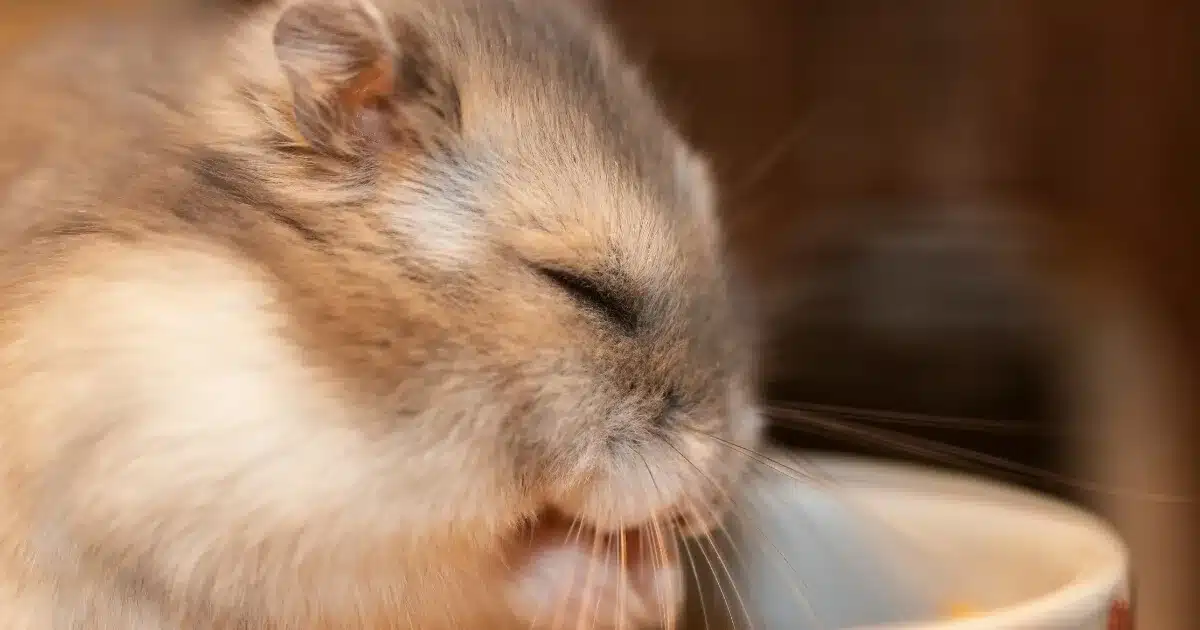
A common question for anyone considering adopting a hamster is: are hamsters nocturnal? As simple as the question might seem, the answer is actually a bit more complicated.
If you’ve done any research on the topic online, you’ve likely seen at least a few conflicting statements. So are hamsters nocturnal, or are they crepuscular or diurnal?
In this article, we’ll answer the question as best we can based on the current research on the sleeping habits of hamsters.
Pet Hamsters vs. Wild Hamsters Sleeping Habits
First, it’s important to differentiate between wild hamsters and pet hamsters when we’re discussing whether hamsters are nocturnal.
Because the lives of wild hamsters are quite different from the lives of pet hamsters, the two can also demonstrate different sleep behaviors.
Wild hamsters may be crepuscular or diurnal
Research on wild hamsters is limited, as most research is conducted on hamsters kept in captivity.
However, the limited research has shown that at least golden (Syrian) hamsters are diurnal in their natural habitat (Biology Letters, 2008). “Diurnal” means that hamsters are active during the day and sleep or stay underground at night.
Anecdotal evidence suggest that wild hamsters may show crepuscular behavior, which means they are most active at dawn and dusk.
Pet hamsters are usually nocturnal or crepuscular
Pet hamsters show more nocturnal behavior than their wild counterparts, often coming out only at night. Many owners notice that their hamsters are like ghosts: they never see their pet, but they notice that food and water are being consumed every day. This has led to the term “ghost hamster,” which describes hamsters who have this behavior.
Hamsters are solitary animals, which means they tend to avoid interaction with other animals, including humans. They are also a prey species, which means they are hard-wired to flee from perceived predators.
So even if you have a trusting relationship with your hamster, their natural instincts will often make it more comfortable for them to stay underground when you’re around.
Learn more: Gerbil vs. Hamster: Which Pet is Right for You?
Hamsters’ Sleeping Schedules Are Flexible
If there’s anything we can learn from the research and anecdotal evidence about hamsters’ sleeping habits, it’s that hamsters are very flexible in when they sleep and when they’re awake.
Depending on a hamster’s temperament and environment, they might become more nocturnal in captivity as a way to ensure their own safety, or they may be curious and come out more during the day.
Hamsters each have different temperaments and personalities, so your experience with your hamster may differ significantly from the experiences of other hamster owners.
How to Help Your Hamster Get Enough Sleep
Because most of us are active in our homes during the day when a hamster might be trying to sleep, you might be wondering if you’re disrupting your ham’s naps. Here are some ways to help make sure your hamster is getting enough shut-eye:
Provide ample bedding
The most important thing you can do is make sure that your hamster has enough bedding. Specifically, your hamster enclosure should have soft bedding, like paper bedding, in at least part of the tank. You can also mix paper bedding with aspen or hemp to create better burrowing material that holds up tunnels well.
Giving your hamster at least 8 inches of bedding (and preferably more like 12 inches) in about ⅓ of the enclosure or more, will ensure that they can dig deep, cozy burrows that drown out much of the sound in your home.
Learn more: What’s the Best Hamster Bedding? Safe Products and Tips
Get the Free Hamster Owner's Toolkit
Printable care tools made for hamster owners. Chore chart, weight tracker, and more delivered to your inbox.
Create pre-made burrows
Some hamsters enjoy digging their own burrows and making them their own, but did you know that most hamsters prefer to occupy pre-made burrows in the wild?
Many species of hamster prefer to find burrows dug and abandoned by other rodents, like gerbils, and make their homes there.
You can help your hamster feel more comfortable by creating pre-made “burrows” within their bedding. Use natural tunnels like these, or link together a series of paper towel and toilet paper rolls.
Layer them throughout the bedding, and make sure your hamster can navigate through the system down to the lowest point.
Place hides around the enclosure
Most hamsters prefer to sleep underground, but some may wish to take an above-ground nap every once in a while.
To make sure they feel comfortable doing this, place different types of hides around the enclosure. For our recommended hides, visit our small pet product recommendations page.
Place your hamster enclosure out of the way
It might be tempting to put your hamster’s enclosure front and center in the living room of your home. But this can be stressful for some hamsters. It’s often better to put the enclosure somewhere that’s quiet during the day, such as a bedroom.
This may work if your hamster doesn’t make too much noise at night. Otherwise, choose a corner that’s more quiet and out of the way.
Not sure if your current setup is giving your hamster enough space to feel secure? Our best hamster cages guide covers enclosures that make it easier to create a calm, comfortable environment.
Maintain a comfortable temperature
Hamsters are sensitive to changes in temperature, so it’s important to make sure their area is at a stable, comfortable temperature.
The best temperature range for a hamster is between 65 and 75 degrees Fahrenheit. Temperatures below 60 or above 80 degrees can lead to torpor in your hamster or heat stroke.
Are Hamsters Nocturnal: FAQs
It’s common to wonder about your critter’s sleeping habits. Here are some of the most frequently asked questions about the schedule of a hamster’s sleep.
Can hamsters see in the dark?
Hamsters have poor eyesight in general, and their vision is even worse at night. This is why hamsters are more likely to be crepuscular or diurnal in the wild. They can see more clearly when there is at least some sunlight.
Should you give a hamster a light at night?
Since your hamster can’t see in the dark, you might be understandably wondering if you should provide some light for them to see by.
It’s not necessary to leave a light on for your hamster–most homes have enough ambient light at night for a hamster to see well enough.
But if you want to brighten things up, try a gentle, dim night light that replicates moonlight. It’s important not to confuse the hamster and make them think it’s daylight during the night.
Do hamsters make noise at night?
Hamsters have a bad reputation as a pet that will keep you up at night. However, this is usually the result of a low-quality exercise wheel.
Hamsters can run tens of thousands of revolutions on their wheel each night, so if noise is important to you, it’s essential to have a silent wheel.
We always recommend the Niteangel Super-Silent Exercise Wheel because it is truly silent and made of high-quality, hamster-safe materials.
Should you wake your hamster during the day?
It can be tempting to wake up your hamster during the day to interact with them, but doing so can result in a grumpy hamster who’s not interested in playing.
Waking your hamster up too often can build a sense of distrust, leading to you seeing even less of your hamster than you already do. The best strategy is to keep an eye out for your hamster and visit them when they awaken. Make sure to come bearing treats!
Is my hamster sleeping too much?
Many people notice that their hamster appears to sleep all the time, but usually, their hamster is just active when they’re not around.
If you’re still noticing that your hamster is eating and drinking, they are probably just being active at night when you’re not around.
If your hamster is not eating or drinking, it’s important to locate them in their enclosure right away and take them to an exotic vet if necessary.
Do hamsters hibernate?
Wild hamsters can enter a hibernation-like state called torpor when food is scarce or the weather is unfavorable. Pet hamsters, however, cannot safely enter and exit torpor because their metabolisms are not used to this process.
If your hamster appears to be in hibernation, warm them up with a hot water bottle or pet heating pad, and schedule an appointment with your exotic pet vet.
Learn more: Best Hamster Cages and Enclosures in the US
Understanding Your Hamster’s Sleeping Habits
While the answer to the question, “Are hamsters nocturnal?” isn’t as straightforward as we would like, there is valuable information to be gleaned from the available research and anecdotes from hamster owners.
In captivity, hamsters tend to be nocturnal, which means they’re only active at night. However, some hamsters are crepuscular in captivity, meaning they’re most active at dawn and dusk.
The best thing you can do to understand your specific hamster’s habits is to observe them and provide them with everything they need for comfortable, restful sleep.
Sources:
- Gattermann R, Johnston RE, Yigit N, Fritzsche P, Larimer S, Ozkurt S, Neumann K, Song Z, Colak E, Johnston J, McPhee ME. “Golden hamsters are nocturnal in captivity but diurnal in nature.” Biol Lett. 2008 Jun 23;4(3):253-5. doi: 10.1098/rsbl.2008.0066. PMID: 18397863; PMCID: PMC2610053. (https://www.ncbi.nlm.nih.gov/pmc/articles/PMC2610053/).
- Aissa A. Martin, Michael G. Tannenbaum, Susan De Mesquita. “Sleep and respiratory patterns in the Djungarian hamster,” Physiology & Behavior, Volume 48, Issue 5, 1990, Pages 669-673, ISSN 0031-9384, https://doi.org/10.1016/0031-9384(90)90209-M.


0 Comments