
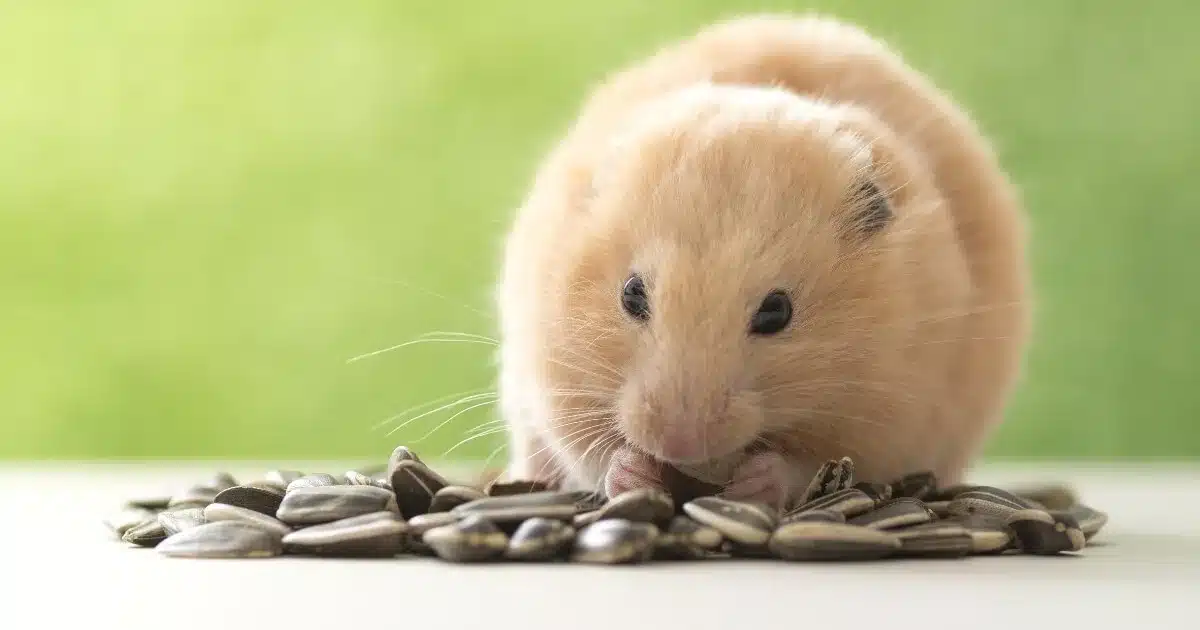
When I first got my hybrid dwarf hamster, I picked the first food I saw on the pet store shelves labeled “hamster food.” It was artificially colored, my hamster wouldn’t eat the pellet pieces, and I eventually learned it wasn’t appropriate for hamsters at all.
If you did the same thing, you’re certainly not alone. Unfortunately, much of the commercial food that’s marketed towards hamsters isn’t suitable for them.
The problem is that you can’t walk into a pet store and buy something high quality off the shelf. The best options aren’t marketed to hamsters, and the one good seed mix that is widely available (Higgins Sunburst) isn’t obvious unless you already know to look for it.
In this article, we’ll let you know the best food for hamsters that you can buy, what we actually feed, and what to avoid.
The basics: your hamster needs a combination of a quality pellet and a seed mix, plus small amounts of fresh food and treats. Not pellets alone, not seeds alone, both. And the best pellets for hamsters aren’t even marketed to hamsters.
Want to understand the science behind hamster nutrition? Our complete hamster nutritional guidelines covers species-specific needs, macronutrient ratios, and the research behind what hamsters need. This page focuses on what to buy.
For the full picture of hamster care beyond food, start with our hamster care guide.
Jump ahead:- Quick Comparison
- Why Rat Food Beats “Hamster Food”
- Best Pellets for Hamsters
- Best Seed Mixes for Hamsters
- Best Food by Breed
- How Much and How Often to Feed
- Fresh Food and Treats
- Foraging Sprays
- Unsuitable Hamster Foods
- FAQ
Quick Comparison
| Product | Type | Protein | Species | Where to Buy | |
|---|---|---|---|---|---|
| Mazuri Rat & Mouse Diet | Pellet | 23% | All | Petco, Amazon | See Price → |
| Teklad 2018 | Pellet | 18% | All | Amazon | See Price → |
| Science Selective Hamster | Pellet | ~16% | All | Amazon | See Price → |
| Kaytee Forti-Diet | Pellet | ~17% | All | Pet stores, Amazon | See Price → |
| Higgins Sunburst | Seed mix | Varies | All | Pet stores, Amazon | See Price → |
| RobinsGourmet Mixes | Seed mix / Fortified | 18-21% | Species-specific | Etsy, robinsgourmetfood.com | See Price → |
| Henry’s Hamster Food | Baked clusters | ~18% | All | henryspets.com | See Price → |
All pellets listed are omnivore-formulated, not hay-based. See unsuitable hamster foods for why this matters.
Why Rat Food Beats “Hamster Food”
This is the single most counterintuitive thing about feeding a hamster, and it’s the reason most new owners get it wrong.
Most pellets with a hamster on the packaging are hay-based. They’re green, they look healthy, and they’re formulated the same way as rabbit or guinea pig food. The problem is that hamsters aren’t herbivores. They’re omnivores. Their digestive systems aren’t designed to extract much nutrition from hay.
A hay-based pellet might list 16% or 18% protein on the label, but if that protein comes primarily from hay, your hamster is absorbing very little of it. The nutrients pass through without being properly digested. Over time, this can lead to malnutrition even though your hamster appears to be eating plenty.
Because hamsters are omnivores, protein is a very important factor in hamster food. Look for a food that has 15% to 20% guaranteed protein content from digestible sources.
Rat and mouse pellets are formulated for omnivores. The protein sources are more bioavailable for hamsters, and the nutritional profile is a much better match. This is why you’ll see experienced hamster owners and organizations like the California Hamster Association recommend rat food pellets over hamster-branded pellets. It’s not a hack or a workaround. It’s genuinely better nutrition.
For more on why pellets matter, see our article on whether hamsters need lab blocks.
How to spot a bad pellet: If it’s green, it’s probably hay-based. Check the ingredients list. If the first ingredient is Timothy hay, alfalfa, or any type of grass, it’s formulated for herbivores, not your hamster.
Best Pellets for Hamsters
Now let’s take a look at our specific recommendations for the best pelleted hamster food you can buy. These are the pellets we recommend pairing with a seed mix.
Mazuri Rat & Mouse Diet
[INSERT: Mazuri Rat & Mouse Diet product photo]

Mazuri Rat & Mouse Diet is a staple in most experienced hamster owners’ supply. Mazuri is used by veterinarians and zoos worldwide, and it has one of the highest protein contents among commonly available pellets. The formula is designed for omnivorous rodents, which is exactly what hamsters are.
I rotate Mazuri into my hamster’s diet, and she nibbles on the pellets throughout the day rather than eating them all at once. Most hamsters find Mazuri palatable, and it’s widely available at Petco and online.
If you’re going to pick one pellet and not overthink it, Mazuri is the safest bet.
Get the Free Hamster Owner's Toolkit
Printable care tools made for hamster owners. Chore chart, weight tracker, and more delivered to your inbox.
Teklad 2018 Rat Food Pellets

Although Teklad’s rat food pellets are formulated for rats, they offer the complete nutritional profile that a hamster needs. The 2018 formula, in particular, is suitable for hamsters because it contains 18% protein.
This is my primary pellet. My hamster nibbles on these over time rather than devouring them in one sitting, which is typical.
It’s important to note that Teklad is a scientific supply company that creates this diet for lab animals. While this means that the pellets are well-formulated and consistent, supporting a lab animal supplier may not be something you’re interested in. If that matters to you, there are good alternatives below.
Science Selective Hamster

Science Selective is a newer option for hamsters that’s gained popularity, particularly among owners who prefer not to buy from lab suppliers. It’s one of the few hamster-specific pellets that’s actually formulated appropriately, with digestible protein sources rather than a hay base.
RobinsGourmet uses Science Selective in their fortified seed mixes, which is a good endorsement of its quality. It’s less widely available in the US than Mazuri or Teklad, but you can find it online.
We haven’t used this one personally, but it has a solid reputation in the hamster community and is worth considering if the lab supplier issue matters to you.
Kaytee Forti-Diet Pro Health

Kaytee Forti-Diet pellets are similar in formulation to the above options. It’s the most widely available choice on this list, and you can find it at most pet stores. It’s formulated with probiotics and DHA, and the protein content is adequate.
It’s not as precisely formulated as Mazuri or Teklad, but it’s a solid budget option and infinitely better than the hay-based pellets that fill pet store shelves. If accessibility is your biggest concern, this is a good choice.
Best Seed Mixes for Hamsters
Hamsters should never subsist on pellets alone. They need a mix of textures and flavors to keep them mentally stimulated and interested in their food. A seed mix provides a similar experience to what they would have in the wild foraging for food.
Always scatter-feed your seed mix rather than putting it in a bowl. Scattering it through the bedding forces your hamster to forage, which is both mentally stimulating and closer to natural behavior. The only exception is hamsters with mobility issues or blindness, who may need food placed where they can find it.
These are the seed mixes that we recommend.
Higgins Sunburst
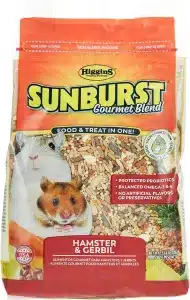
Higgins Sunburst seed mix is what’s recommended by most hamster owners and hamster advocates. It is an affordable seed mix with a variety of different seeds and food sources that supply a well-balanced mix of nutrition.
This is my go-to seed mix. I pair it with Teklad or Mazuri pellets. My dwarf hoards most of the scattered seeds and picks out her favorites first (sunflower seeds, naturally). She mostly ignores the small millet seeds and stashes them in her burrow rather than eating them, but the overall variety keeps things interesting.
The one downside is that Higgins isn’t species-specific. It’s labeled for “hamsters and gerbils,” and ideally a dwarf hamster and a Syrian hamster would have slightly different seed mixes. For most owners, this is a perfectly good option. If you want something more tailored, see RobinsGourmet below.
RobinsGourmet Species-Specific Seed Mixes
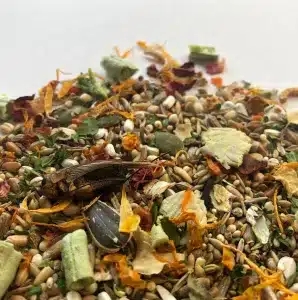
RobinsGourmet is a small business selling species-specific seed mixes. This means that each mix can be formulated to suit a specific hamster species: Syrian, Russian/Chinese dwarf, or Roborovski. Each species has different nutritional needs (more on that in the best food by breed section below), and RobinsGourmet accounts for all of them.
They now offer several tiers of mixes:
- Fortified mixes include Science Selective pellets pre-mixed in, so you don’t need to buy a separate pellet. This is the most convenient and nutritionally complete option.
- Gourmet (pellet-free) mixes are designed to be paired with a pellet of your choice. These are the most popular option.
- Basic mixes are lower-cost and don’t include animal protein, so you’d need to supplement with both a pellet and a protein source.
They also sell vegetable blends and herb mixes as supplemental additions.
RobinsGourmet has over 6,000 reviews on Etsy and now has their own website at robinsgourmetfood.com. The mixes are more expensive than Higgins, but the species-specific formulation and ingredient quality justify it if your budget allows. They also offer 100g trial packages if you want to test before committing to a full bag.
If I’d known about RobinsGourmet when I first got my hamster, I would have started here. You just can’t find this level of species-specific formulation on a pet store shelf.
Henry’s Hamster Food (Premium Option)

Henry’s is a newer option that takes a different approach. Instead of loose seeds or pellets, their food comes as baked clusters made from 100% human-grade ingredients. It’s soy-free, low-glycemic, and fortified with vitamins and minerals.
The catch: it requires refrigeration and has a shorter shelf life (about 3 months refrigerated). It’s also the most expensive option on this list.
We haven’t personally used Henry’s, so we can’t speak to palatability from our own experience. But it has a dedicated following among owners who want the highest-quality ingredients and are willing to pay for it. Reviews consistently mention that hamsters take to it well after a brief adjustment period.
Best Food by Breed
Not all hamsters should eat the same thing. Different species have different dietary tolerances, which affects which products to choose. If you’re not sure what species you have, check our guide to different types of hamsters.
Best Food for Syrian Hamsters
Syrians are the most straightforward to feed. Any of the pellet and seed mix combinations above will work well. Aim for 15% to 20% protein. Syrians can tolerate more variety in fresh foods and treats than dwarf breeds.
Best Food for Dwarf Hamsters (Campbell’s, Winter White, and Hybrids)
Dwarf hamsters are prone to diabetes, so the key is limiting sugar. If you use Higgins Sunburst, pick out any dried fruit pieces. Better yet, use RobinsGourmet’s Russian/Chinese dwarf formula, which is specifically designed with low sugar content.
Keep fresh fruit treats to an absolute minimum, once a week at most.
If you’re not sure what species your dwarf hamster is, you likely have a hybrid (Campbell’s x Winter White). Feed as you would a Campbell’s, with diabetes prevention in mind.
Best Food for Roborovski Hamsters
Robos need a lower-fat diet because they’re prone to lipomas (fatty tumors). RobinsGourmet makes a Robo-specific mix that accounts for this. If you’re using a general mix, limit high-fat seeds like sunflower seeds and peanuts.
Best Food for Chinese Hamsters
Chinese hamsters can generally be fed the same way as Campbell’s/Winter White hamsters, with the same attention to sugar content.
How Much and How Often to Feed
Knowing how much to feed a hamster can be difficult because they hoard their food. You won’t always know whether a hamster has gone through all of their food yet or not. Here are practical guidelines:
- 1-2 teaspoons of food per day for dwarf hamsters
- 1-2 tablespoons of food per day for Syrian hamsters
These measurements include the pellets, seed mix, and other snacks you give your hamster.
Scatter feeding
Always scatter-feed your seed mix through the bedding rather than using a bowl. Foraging is an enrichment need, not just a feeding method. Scatter more food as soon as all of the scattered food appears to be gone.
I scatter feed whenever I can’t see any food on the surface of the bedding anymore, which for my dwarf is usually about every three days. She hoards most of it in her burrow, so the visible food disappears fast even though she hasn’t eaten it all yet.
Some hamster owners argue that you should only feed a hamster once all of their hoarded food has been eaten. However, this can be very stressful for a hamster and goes against their natural instincts to maintain a stash of nutrition.
The only exception to scatter feeding: hamsters with blindness or mobility issues that make foraging difficult. In that case, place food in a consistent, accessible location.
Why pellets matter for picky eaters
Your hamster will always selectively eat their seed mix and won’t necessarily get a complete nutritional profile. This is the main reason we recommend a pellet in addition to a seed mix.
My hamster picks the sunflower seeds out of the Higgins mix first and mostly ignores the small millet seeds. The Teklad pellets ensure she’s still getting balanced nutrition even when she’s being choosy.
Fresh Food and Treats
In addition to pellets and seed mix, hamsters benefit from small amounts of fresh food and occasional treats. Here’s a quick reference. For a complete list of safe foods and more detail on portions, see our hamster nutritional guidelines.
Safe vegetables (a few times per week): Broccoli, carrot, cucumber, kale, spinach (in small amounts), sweet corn, lettuce (romaine, not iceberg), basil, chard
Safe fruits (limit for dwarf breeds due to sugar): Blueberries, blackberries, raspberries, apple (no seeds), pear, banana (small amounts). We also have guides on strawberries, watermelon, and grapes if you want specifics. For dwarf hamsters, limit fruit to no more than once per week.
Protein sources: Mealworms (dried or live), plain cooked chicken (unseasoned), boiled egg, scrambled eggs. Hamsters are omnivores, and protein is an important part of their diet.
Treats for bonding: Small treats like individual sunflower seeds, pumpkin seeds, or tiny pieces of vegetable work well for hand-feeding during bonding sessions. For more ideas, check out our guide to homemade treats for hamsters.
What to avoid as treats: Yogurt drops and honey-coated treats marketed for hamsters are essentially candy. They’re high in sugar and offer no nutritional value. Skip them.
Foraging Sprays
Foraging sprays are dried stalks of grains and grasses with the seeds still attached. They’re one of the best enrichment items you can add to your hamster’s enclosure, and they double as a food source.
Sprays encourage your hamster to work for their food the way they would in the wild. Instead of just picking seeds out of bedding, they have to strip seeds off a stalk, which keeps them busy and provides mental stimulation. The stalks themselves also help with dental health, since your hamster will gnaw on them.
Types of sprays
The most common foraging sprays for hamsters include:
- Millet sprays are the easiest to find and the most popular. You can buy them at most pet stores (they’re usually sold in the bird section). Most hamsters love millet. My dwarf goes straight for millet sprays before anything else in her enclosure.
- Oat sprays are high in fiber and a great option for variety. The seeds are larger than millet, so they take a bit more effort for your hamster to harvest.
- Flax sprays are rich in omega-3 fatty acids. Some hamsters go wild over these. Because they’re higher in fat, don’t overdo it. A couple of stems per week is plenty.
- Amaranth sprays are high in protein and add nice variety. They’re less common in pet stores but easy to find online.
You can also find wheat, sorghum, canary grass, and chia sprays from specialty sellers.
Where to buy
Millet sprays are available at most pet stores in the bird aisle. For other types of sprays, Etsy is the best source. Small Sprouts Co and Hamsters We Love are popular sellers with good quality products. RobinsGourmet also sells sprays alongside their seed mixes.
Tips for using sprays
You can stick sprays upright in the bedding so your hamster has to reach up and pull seeds off, or lay them flat for easier access. Either way, your hamster will strip the seeds, pouch them, and haul them back to their hoard.
One important tip: freeze any sprays for at least 48 hours before putting them in the enclosure. This kills any bugs that might be hiding in the seeds. This goes for sprays from any source, even reputable sellers.
Unsuitable Hamster Foods
As mentioned, not all hamster foods are actually safe for our pets. In fact, most foods marketed towards hamsters are actually not suitable for them.
You may notice that only the RobinsGourmet food above is actually targeted towards hamsters. This is an example of a targeted diet that is done right. Others typically fall short.
Hay-based pellets (including Oxbow)
In particular, pellets marketed towards hamsters are often hay and grass-based, which is great for rabbits and guinea pigs but not for hamsters. That’s because the former are herbivores, while hamsters are omnivores.
If a pellet is green in color, it’s probably made from Timothy hay.
The problem with this is that hamsters don’t digest hay very well. So even if a food states it has 18% protein, if most of the protein comes from hay, hamsters will get very little of that.
For this reason, pellets designed for rats are usually more nutritionally acceptable for hamsters than those marketed towards hamsters.
Oxbow is a specific example worth calling out. Despite being widely sold and recommended at Petsmart, Oxbow’s hamster food uses Timothy hay as its primary ingredient. The California Hamster Association has spoken out strongly against Oxbow for this reason, noting that hay-based diets can lead to malnutrition over time.
Colorful pet store mixes
Mixes with bright red, green, and yellow pieces are using artificial dyes. These offer no benefit and may contain filler ingredients, added sugars, and molasses. Brands like Kaytee Fiesta fall into this category. There’s no reason to artificially color a hamster pellet. Your hamster doesn’t care what color their food is.
“Complete” seed-only mixes
Some mixes claim to be nutritionally complete but are just a bag of seeds with a few dried vegetables. These lead to selective eating and nutritional gaps. A seed mix should always be paired with a pellet unless you’re using a specifically formulated mix like RobinsGourmet’s fortified line.
Specific products to avoid
- Oxbow Essentials Hamster & Gerbil Food (hay-based, inappropriate for omnivores)
- Wild Harvest / Snak Shacks (sawdust-based products that are neither edible nor digestible)
- Any pellet where the first ingredient is Timothy hay or alfalfa
- Yogurt drops, honey sticks, and sugar-coated treats
- Muesli-style mixes heavy in corn and flaked cereals with little actual seed variety
Feeding Your Hamster a Healthy Diet
There are many different opinions out there about what a hamster should or should not eat. But by and large, the foods listed above have been chosen as the “gold standard” of feeding a pet hamster.
A combination of one of the pellets and one of the seed mixes above is a good starting place, and it’s a combination of food sources that will sustain your hamster and keep them enriched long-term.
For more evidence, information, and research about what a hamster should eat, view our Hamster Nutritional Guidelines.
FAQ
Why do hamster owners feed rat food?
Because hamsters are omnivores, like rats, not herbivores. Rat and mouse pellets are formulated with protein sources that hamsters can actually digest and absorb. Most pellets marketed to hamsters are hay-based and designed for herbivore digestion, which is a poor nutritional match.
Can hamsters eat only pellets?
Technically, a hamster can survive on pellets alone, but we don’t recommend it. Hamsters need variety for mental stimulation and enrichment. A pellet-only diet removes the foraging experience that’s essential for their wellbeing. Always pair pellets with a quality seed mix.
Is Oxbow hamster food good for hamsters?
No. Despite being widely sold and recommended at Petsmart, Oxbow’s hamster food is hay-based. Hamsters are omnivores and don’t efficiently digest hay, so much of the listed nutrition passes through without being absorbed. We recommend rat/mouse pellets like Mazuri or Teklad instead, or even Oxbow’s Rat & Mouse food.
How much should I feed my hamster per day?
Dwarf hamsters need about 1 to 2 teaspoons per day. Syrian hamsters need 1 to 2 tablespoons per day. This includes pellets, seed mix, and any fresh foods or treats. Scatter-feed the seed mix through the bedding for foraging enrichment.
What’s the best food for a dwarf hamster with diabetes?
Focus on low-sugar options. Avoid seed mixes with dried fruit or added sugars. Use a species-specific mix like RobinsGourmet’s Russian/Chinese dwarf formula, which is designed for diabetes-prone breeds. Limit fresh fruit treats to once a week at most. Pair with a quality pellet like Mazuri or Teklad for consistent nutrition.
Should I scatter-feed or use a bowl?
Scatter-feed. Hamsters are natural foragers, and scattering food through the bedding mimics that behavior. It’s mentally stimulating and prevents boredom. Only use a bowl if your hamster has mobility issues or blindness that makes foraging difficult.
How do I stop my hamster from only eating the sunflower seeds?
This is called selective eating, and it’s the main reason we recommend pairing a seed mix with pellets. The pellets ensure your hamster gets baseline nutrition even if they cherry-pick the seed mix. You can also wait until most of the scattered food is gone before adding more, which encourages them to eat less-preferred items. Don’t remove individual ingredients from the mix, as this throws off the nutritional balance.
Can hamsters eat fresh fruits and vegetables?
Yes, in small amounts. Safe vegetables include broccoli, carrot, cucumber, and leafy greens. Fruits should be limited due to sugar content, especially for dwarf breeds prone to diabetes. Avoid citrus, garlic, onion, and anything sticky that could get stuck in cheek pouches.


0 Comments